
Two weeks ago, at the 2026 DVPT Conference, I had the opportunity to give a presentation titled “Why the Digital Mailroom Is the Foundation for Future Enterprise AI.”

In order to use AI applications in companies profitably and efficiently in the future, data contained in documents is of crucial importance. In recent months, we have been able to help a number of companies to read archived documents, systematically understand them better and convert them into structured data. The main driver: the realization that data must be available in order to make broader use of AI.
The archive is yesterday’s inbox, so to speak
Now all these documents, which have often been stored in the basement for several years, had to come into the company at some point. You guessed it, these documents probably entered the company at some point via the mailroom. So if you want to prevent the archive situation – whether digital or on paper – in the future, you have to start with incoming mail.
Two categories of data: Data for the process and data for the future
What I see time and again is that customers extract only the specific data from documents that is needed for the actual process. For example, the invoice data required for auto insurance claims. However, the invoice sent by the repair shop contains a wide range of data points that are valuable to an insurance company. Think about spare part prices, repair options, sociodemographic data, and much more.
This data can be very useful for all kinds of analyses and product iterations.
Preemptive data collection
What I see comparatively often is that the moment an AI application is considered in a company, it is only realized that the data is not even available. The conclusion from this can only be that data from documents must be procured from the current input management streams, so to speak. This is where the Digital Mailroom comes into play.
It is the ideal gatekeeper for all documents that come into the company. Over the years, I believe I have come to realize that there are three different levels of digital mailroom. I would like to explain these below.
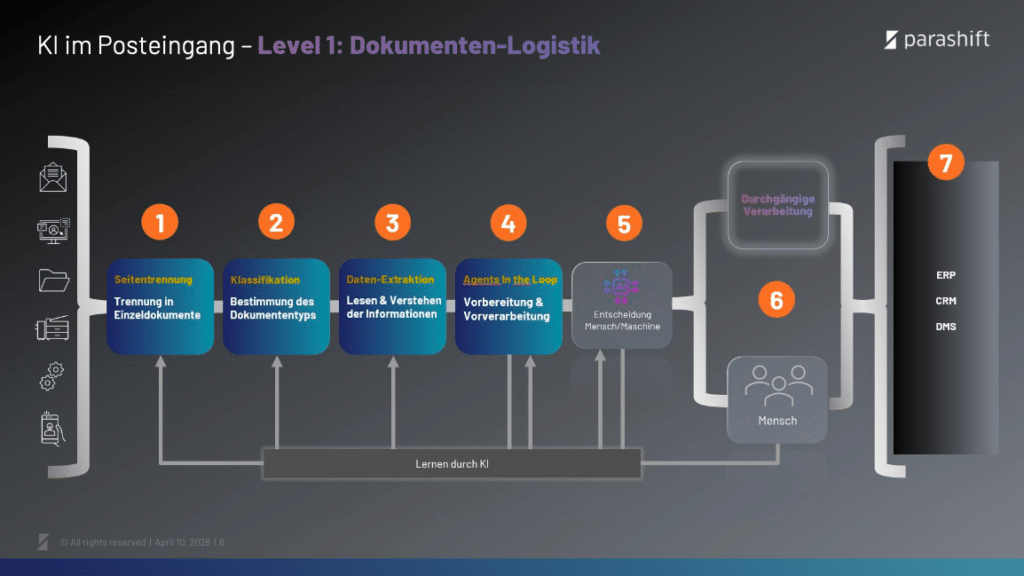
Level 1: Document logistics
The first level is what we have long understood by the digital mailroom, sometimes with more or less AI – it’s basically about document logistics: roughly classifying documents, reading out, matching and validating data and “downstreaming” it into subsequent systems.
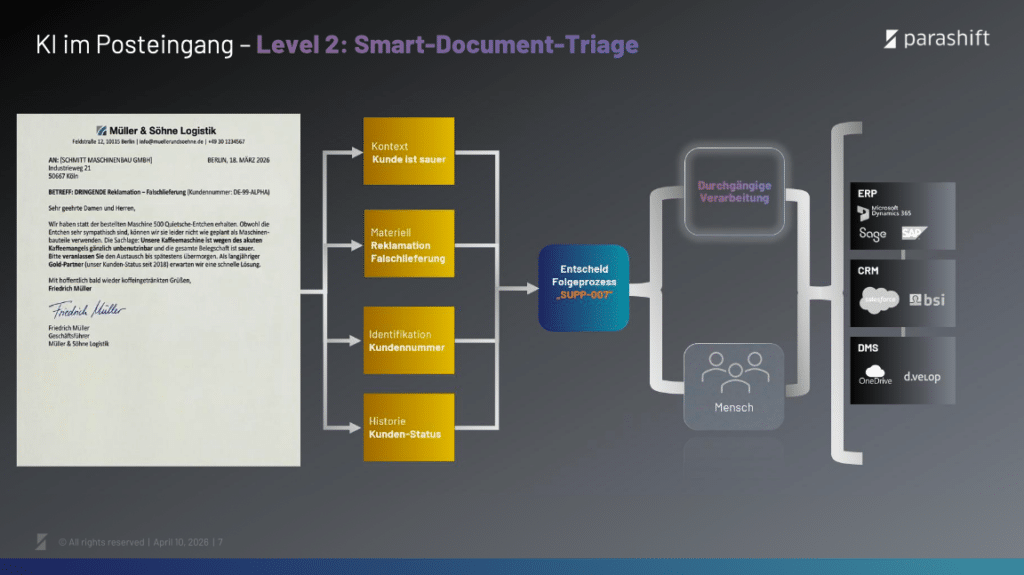
Level 2: Smart document triage
At Parashift, we call the second level “Smart Document Triage” and is a big topic right now. It naturally includes the document logistics of level 1, but goes beyond that: content is contextualized and instead of simply doing “process logistics”, various AI models decide what should happen next with the process in the mailroom context. Basically, we are covering “yes, but” handling. On the one hand, there are relatively rigid document logistics rules as a foundation, but there is a “contextualization layer” that decides which processes should be used in the company. To be on the safe side, there is also a human “trust layer” for these decisions in the form of extensive human-in-the-loop exception handling.
Level 3: “Food for the AI machinery”
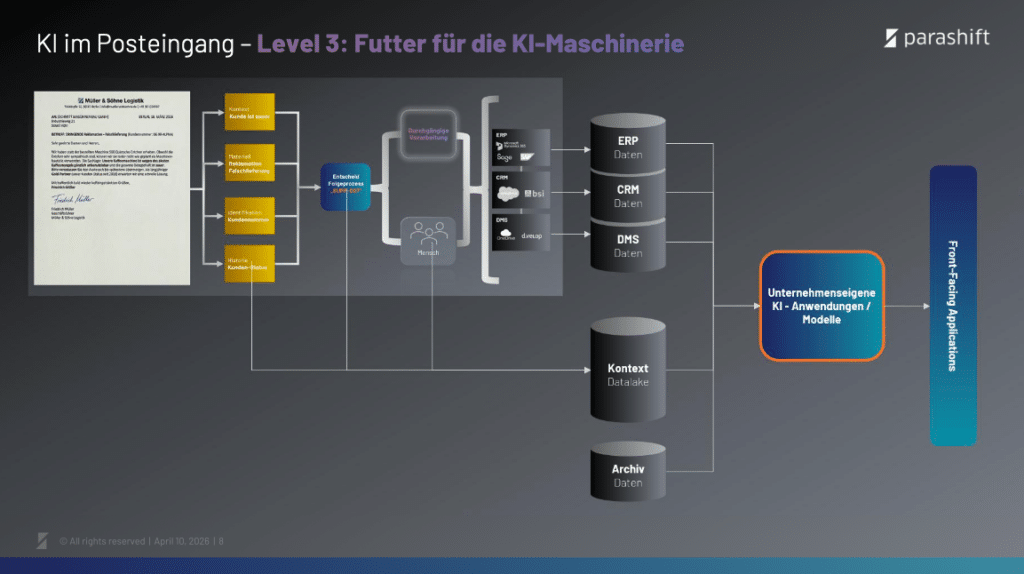
Yes, and Level 3 in this classification is then Level 1 and Level 2 for the efficiency gains and supplements the processing with the pre-emptive collection of as much data as possible from the input management stream, in stock, so to speak.
This data is recorded in a data lake and will be available for all kinds of applications in the future.
Conclusion
Today, companies should concentrate on their duties instead of celebrating the freestyle in AI experiments. Creating a clean, digital database by automating input management is the prerequisite for benefiting from advanced AI later on. And – to avoid having to “digitize” digital document archives again in 10 years’ time.
Related
Try Parashift on your own documents: test it in the playground, book a demo or get in touch.

