

With the decision of the German Bundestag on 15 October 2026, it is now settled how extensively the Medical Service (Medizinischer Dienst, MD) will audit hospital invoices from 2027. The permitted audit rate for a hospital depends even more than before on how many of its audited invoices remain undisputed, and the gaps between the classes are wide. For hospital management and medical controlling, the undisputed-invoice rate becomes the figure that sets the audit workload for an entire year.
The audit rate classes from 2027
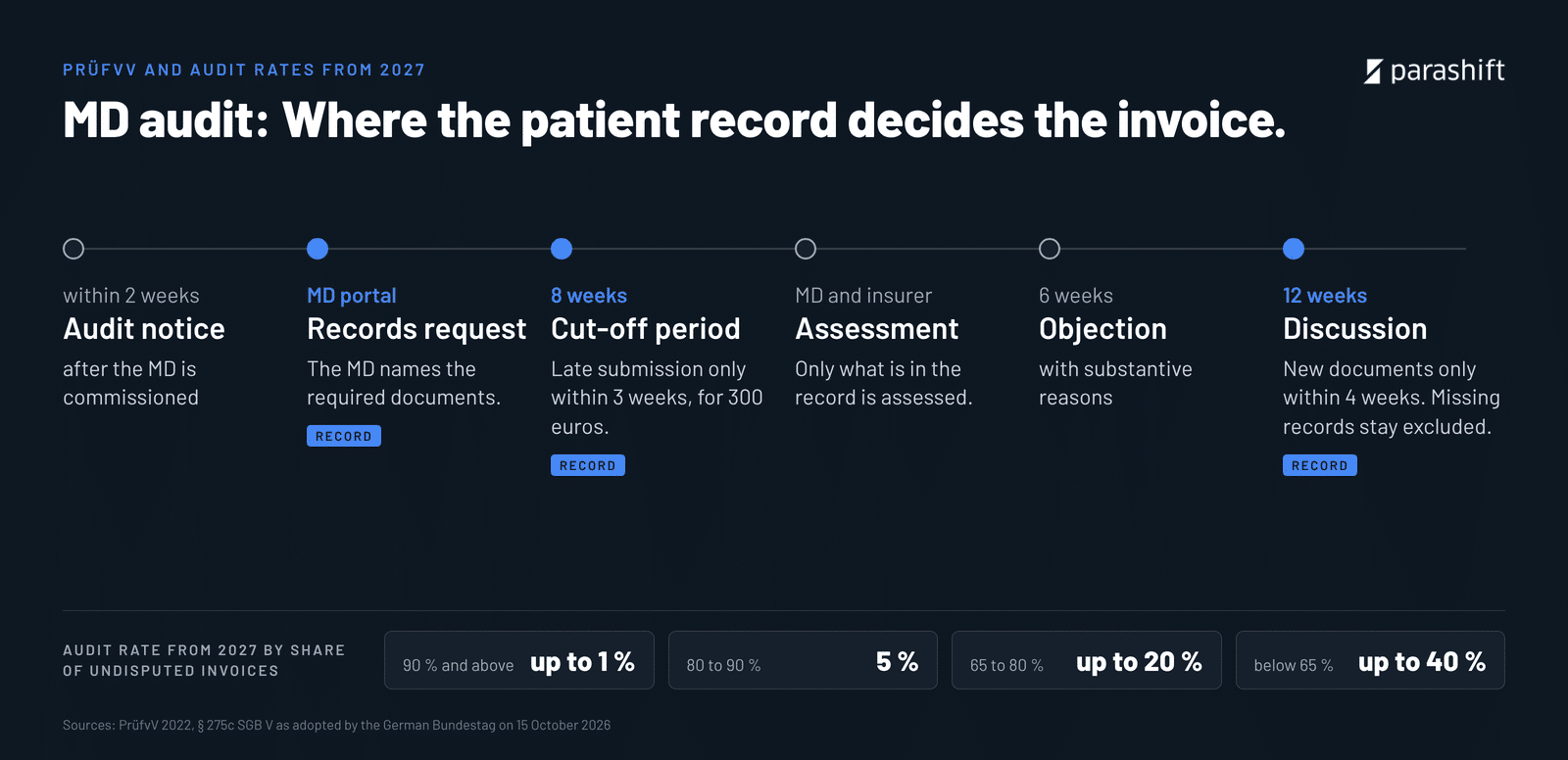
The amendments to the GKV-Beitragssatzstabilisierungsgesetz, passed by the Bundestag together with the emergency care reform, divide the quarterly audit rate under § 275c SGB V into four classes. Hospitals with at least 90 percent undisputed invoices are audited in up to one percent of cases, hospitals between 80 and 90 percent in five percent. Between 65 and 80 percent the rate rises to up to 20 percent, below that to up to 40 percent. The first quarter of 2027 is based on the audit results of the third quarter of 2026, which means cases that many hospitals currently have in assessment or in the discussion procedure.
| Share of undisputed invoices | Audit rate from 2027 |
|---|---|
| 90 percent and above | up to 1 percent |
| 80 to under 90 percent | 5 percent |
| 65 to under 80 percent | up to 20 percent |
| under 65 percent | up to 40 percent |
What the audits already tie up today
According to a flash survey by the German Hospital Institute (DKI) on behalf of the German Hospital Federation (DKG) in September 2026, around 4,000 full-time staff in general hospitals work mainly on audit cases. The personnel costs amount to around 245 million euros per year, on average 236,000 euros per hospital. 98 percent of the hospitals surveyed expect more audits in 2027, just over half have hired additional audit staff or plan to, and 51 percent intend to handle audit cases with AI in the future.
The German Society for Medical Controlling (DGfM) puts the time for a single case audit at 2.1 to 3.4 hours and, in its scenario for the extended audit regime, expects an additional need of around 2,000 full-time staff. It describes most of this time not as medical argument but as repeated handling caused by deadlines, queries, late submissions and coordination between physicians, nursing, coding and medical controlling.
Where a case is decided by the patient record
The procedure is governed by the audit procedure agreement (Prüfverfahrensvereinbarung, PrüfvV). The MD gives notice of the audit no later than two weeks after it has been commissioned and requests, through the MD portal, the documents it needs for the assessment. It has to name them specifically, and the hospital may add whatever it considers necessary.
Submission is subject to a cut-off period of eight weeks. After that, documents can only be submitted within a further three weeks and against a payment of 300 euros to the health insurer. Documents that the MD has named and that are not submitted in time cannot be introduced later in the discussion procedure either. If the hospital disputes the insurer’s decision, it has six weeks to do so. The discussion procedure must be completed within twelve weeks, and new documents are only admissible within the first four weeks.
In practice, the effort lies in bringing the requested documents together completely. Part of them is structured in the hospital information system, another part sits in scanned charts, nursing reports, anaesthesia records and external findings attached to the case as PDFs without an index. A further share of disputes arises earlier, during coding: secondary diagnoses documented in an external report are not coded because the report sits in the paper file on the ward, or they are coded and cannot be found in the audit case.
What document AI changes
The first lever is the inbound channel. If external findings, physician letters and prior reports are recognised on arrival, assigned to the right case and indexed by document type and date, coding sees the evidence before the invoice is issued. This has a direct effect on the undisputed-invoice rate, because a documented secondary diagnosis is more likely to withstand an audit than one whose evidence first has to be found. We show what this looks like for the clinical mailroom and legacy records and for referrals and physician reports.
The second lever is the patient record itself. Once every page of a case is recognised by document type, date and case, assembling the requested documents becomes a query. Missing documents become visible while the deadline is still running, not only in the assessment.
For this to hold up in operation, a language model alone is not enough. It takes a validation and automation layer that reports a confidence for every field, passes documents below a threshold to human review and records every machine and human step in an audit log. Why this layer is needed regardless of the model used is described in a separate article.
Running it in-house
Under § 393 SGB V, German hospitals may only have patient data processed in a cloud under strict conditions, including a current C5 attestation of the provider. Many hospitals do not want to let this data leave their own data centre in any case. Our model Dokumentli therefore also runs on a single GPU in the hospital’s data centre. The Parashift Platform passes the results to the hospital information system and archive via HL7 or API, and existing capture and DMS systems remain in place. For processing in our cloud, Parashift holds a C5 attestation.
Initial consultation
We offer hospital management and medical controlling a one-hour initial consultation. Based on your audit figures, your record structure and your inbound channels, we assess which share of the audit workload can be automated by the end of the year. Request a meeting


